
Remote Work Job Scams: The Work-From-Home Trap
 Three Rivers Star Foundation
You’re seeing job offers that demand $500 to $5,000 upfront for “training” or “equipment.” They’re not legitimate. Remote work scams cost job seekers over $220 million in just six months of 2024. Scammers request crypto deposits, send fake checks, and disappear with your money. We’re warning you: walk away from jobs requiring payment before hiring. Check company websites. Verify recruiter emails aren’t Gmail. Trust your gut when something feels wrong. The details behind these traps reveal exactly how to spot them.
The $500 Equipment Purchase That Changed Everything

When you’re desperate for work, a $500 equipment fee sounds reasonable—necessary even. We’ve all been there. The job posting promises remote opportunities. The hiring manager seems legit. Then comes the request: buy your own laptop, software, or phone to start.
When desperate for work, a $500 equipment fee sounds reasonable. Then the hiring manager disappears. No job. No refund. No validation.
Here’s what happens next. You pay. They disappear. No job. No refund. No equipment validation ever occurred.
Real companies don’t demand upfront costs. Period. They provide equipment or reimburse you after you’re hired. In 2024, scammers collected millions this way before vanishing completely. Victims of these advance fee payment schemes lose an average of nearly $5,000, devastating families already struggling financially.
Before paying anything, verify the company directly. Call their official number. Visit their actual website. Check Glassdoor reviews. Ask other employees about equipment procedures.
Don’t become another statistic. Legitimate remote opportunities never require payment upfront.
Why Remote Work Scams Are Exploding Post-Pandemic

We’re watching scammers exploit a perfect storm: remote job demand skyrocketed 49% in 2025 while companies can’t vet candidates fast enough, leaving massive gaps for criminals to slip through.
They’ve adapted too, shifting from old email schemes to slick task scams on texts and WhatsApp—posting identical fake jobs across dozens of sites, collecting upfront “training fees” and crypto deposits from desperate job seekers.
Identity theft incidents increase significantly among those targeted by these scams, making personal information protection critical during your job search.
You’ve got to verify every posting independently, check the recruiter’s actual company email domain, and remember: legitimate employers never ask for money upfront except your own interview travel.
Demand Surge Outpaces Verification
As remote work exploded after 2020, scammers moved faster than companies could verify who they were hiring. We’re facing a verification crisis. Remote tasking platforms became hunting grounds. Between 2020 and 2024, task scam reports skyrocketed from zero to 20,000. That’s not a coincidence. Companies couldn’t keep up. Legitimate hiring slowed. Fake postings multiplied. Scammers exploit the lack of structured interview processes that legitimate companies maintain to vet candidates properly.
| Year | Task Scam Reports | Avg Loss Per Victim | Total Losses |
|---|---|---|---|
| 2020 | 0 | N/A | $0 |
| 2022 | 2,500 | $3,000 | $7.5M |
| 2023 | 5,000 | $4,500 | $22.5M |
| 2024 H1 | 20,000 | $5,000 | $100M+ |
| 2025 | Rising | $5,000 | $170M+ |
We need verification challenges solved now. Check official websites. Demand video interviews. Never pay upfront fees. Trust your gut.
Scammer Adaptation to Remote Trends
Scammers didn’t just follow the remote work boom—they perfected it. Task scam reports exploded from zero in 2020 to 20,000 by mid-2024.
They’re evolving faster than we can warn you. Scammer tactics now target your phone through texts and WhatsApp, not just email. They’ve adapted their remote evolution strategy completely.
Initial payouts look real. Then they demand crypto deposits. You lose everything. Forty percent of 2024 scam reports involved fake app tasks—product boosting schemes that promise quick money. The median loss? Two thousand dollars per victim. Losses hit $220 million in just six months.
They’re patient predators studying how we work now. They know you’re desperate for flexibility.
Don’t fall for it. Verify employers directly. Check official websites. Never pay upfront fees.
The Vulnerability of Work-From-Home Job Seekers

The moment you hit “apply” on that work-from-home job posting, you’re stepping into a minefield. We’re vulnerable. Job seekers like us face unprecedented work from home vulnerabilities in 2024. Task scams quadrupled to 20,000 reports. Our awareness matters now.
| Red Flag | What Happens | Your Risk | Action |
|---|---|---|---|
| Upfront fees | Money vanishes | $5,000 average loss | Reject immediately |
| Crypto demands | Fake commissions | Total loss | Block contact |
| Text-only contact | No paper trail | Identity theft | Verify officially |
| Vague job details | Bait and switch | Time wasted | Research thoroughly |
Scammers hunt remote seekers deliberately. They know we’re desperate. They exploit our job seeker awareness gaps. Check Glassdoor reviews first. Verify recruiter emails—never Gmail addresses. Legitimate companies post on official sites. They don’t demand payment. Ever.
Equipment Purchase Requirements and Upfront Fee Schemes

We’re watching scammers demand upfront payments for equipment, training, or background checks—costs that legitimate employers never ask you to cover before you’re hired and paid.
Here’s what’s happening: task scam operators collect $500 to $5,000 from job seekers under the guise of “laptop setup” or “certification fees,” then pivot to requesting crypto deposits for fake commissions that never materialize.
Stop any employer who asks for money upfront, report them to the FTC, and remember this rule: real companies cover their own hiring costs, period.
Hidden Cost Red Flags
Hidden costs trap job seekers before they even start working.
We’ve seen how job scam psychology exploits remote job myths—that work-from-home positions require zero investment. They don’t. Scammers weaponize hidden fees to separate you from money.
Watch for these deceptive tactics:
- Background check fees ($50-$200) before employment verification
- Software licenses or equipment purchases disguised as “mandatory training”
- Crypto deposits framed as “commission verification” (median $2,000 loss)
- “Onboarding packages” requiring upfront payment
- Technology platform access requiring credit card information
Legitimate companies cover all costs. Period. No exceptions.
The FTC reports upfront job expenses consistently signal fraud. If they’re asking? They’re scamming. Trust your instincts. Verify directly through official company websites. Protect your wallet. Protect yourself.
Legitimate Employers Never Charge
Scammers don’t stop at hidden fees—they escalate to demanding you buy equipment before your first day.
They’ll claim you need a laptop, software licenses, or uniforms. Sound familiar? It shouldn’t. Legitimate employers provide or reimburse equipment costs. Period.
Real job verification means checking employer credibility through Glassdoor, LinkedIn, and official websites—not trusting unsolicited texts.
Scammers collected $220M+ in the first half of 2024 alone. They’re getting bolder.
Before purchasing anything, verify the company exists. Call their main number directly. Ask HR about equipment policies.
Legitimate companies never demand upfront purchases from new hires. If they’re asking for money before employment starts, walk away immediately.
Your safety matters more than any paycheck.
Crypto Deposit Schemes Explained
Task scams have evolved into something far more dangerous than fake postings.
They’re crypto incentive fraud schemes designed to drain your bank account. Here’s how they operate:
- You complete small tasks earning $50-$100 initial payouts
- Scammers build false trust over days or weeks
- They then demand crypto deposits for “verification” or “bonuses”
- Your real money vanishes into untraceable wallets
- Task payout schemes promise $5,000-plus monthly earnings
The numbers tell a chilling story.
Crypto losses in job scams hit $41 million in the first half of 2024—double the entire year before.
Unsolicited texts and WhatsApp messages deliver these traps directly to your phone.
Don’t deposit anything. Ever.
Legitimate employers never ask for cryptocurrency. The moment someone mentions crypto, stop communicating immediately. Report it. Protect yourself.
Fake Check Deposits and Commission-Based Traps
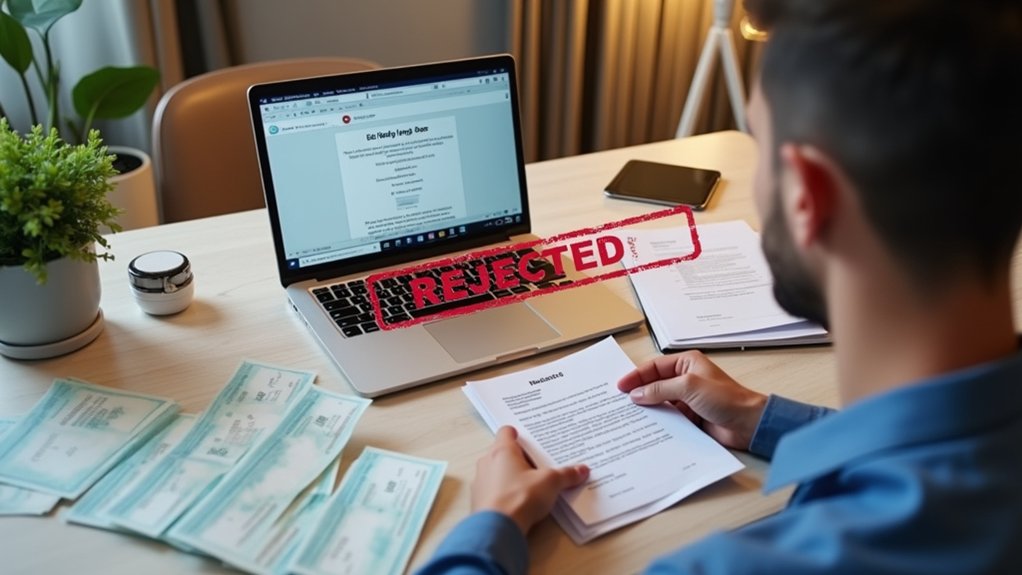
While you’re excited about a job offer with what seems like quick money, the employer asks you to deposit a check and wire back a portion—that’s when everything falls apart.
Fake check schemes work like this: the scammer sends you a check. You deposit it. They claim a “processing error” and demand you wire funds back immediately. The check bounces days later. You’re out thousands.
Scammers send checks, demand wire transfers for “processing errors,” then the check bounces. You lose thousands.
Commission traps operate similarly. You complete tasks. They promise payment. Instead, they demand cryptocurrency deposits for “verification.” Neither payment materializes.
The FTC tracked $220M in losses during 2024’s first half alone. Don’t accept jobs requiring upfront deposits, fees, or wire transfers. Legitimate employers never ask this.
Verify everything through official company websites and phone numbers. Protect yourself now.
Data Entry and Envelope Stuffing Fraud

If you’ve seen job postings promising $500 weekly for typing data or stuffing envelopes at home, you’re likely facing one of remote work’s oldest traps.
We need to expose how these data entry scams work.
Here’s what happens:
- You pay $50–$200 upfront for “training materials” or “starter kits”
- Companies claim you’ll earn thousands stuffing envelopes from your couch
- Initial tasks seem legitimate but demand crypto deposits next
- Real money never arrives. Your upfront fee vanishes instantly
- Red flag: legitimate employers never charge job applicants fees
The FTC reported these schemes target desperate remote workers repeatedly. They’re relentless.
Don’t fall for vague job descriptions lacking company names or websites.
Verify everything through official career pages. Avoid any posting demanding payment before work begins. Period.
Mystery Shopping and Task Scam Operations

Mystery shopping scams work differently than envelope stuffing schemes, but they’ll drain your wallet just as fast.
We see task scam operations exploding—reports jumped from zero in 2020 to 20,000 in early 2024. Here’s how they trap us: You get texted a “simple job” evaluating apps or boosting products. Small payouts arrive first. Then comes the hook. They demand crypto deposits for “commissions.”
We never see that money again. Task scam operations cost victims an average $5,000 each. Some lose more through fake mystery shopping assignments requiring upfront fees.
We must recognize these red flags immediately: unsolicited texts, promised easy money, demands for deposits. Verify employers on official websites and Glassdoor. Never pay upfront. Block suspicious contacts instantly. Protect yourself now.
What Legitimate Remote Work Actually Looks Like

Now that we recognize how scammers operate, we need to flip the script and understand what legitimate remote work actually looks like—because real opportunities do exist.
Real companies don’t ask for upfront fees. They won’t contact you through WhatsApp alone. Instead, they’ll use professional recruitment channels and structured interviews with verifiable team members.
Here’s what legitimate remote work practices look like:
- Official company career pages and LinkedIn profiles with actual reviews
- Background checks handled by professional services, never requested upfront
- Clear job descriptions with specific duties and location-based pay
- Health insurance, 401k, and paid time off included
- Multiple interview rounds with documented hiring processes
Companies like UnitedHealth and Robert Half consistently hire remote workers nationwide.
Job verification matters. Check Glassdoor ratings. Verify recruiter emails aren’t Gmail addresses. Search for duplicate postings across job boards. These steps take minutes but save thousands.
How to Verify a Remote Employer’s Credibility

Knowing what legitimate remote work looks like won’t protect you if you can’t verify the employer’s actually real.
We need remote job verification strategies now. Check Glassdoor reviews and the company’s official website first. Search their LinkedIn presence—legitimate employers maintain active profiles.
Verify recruiter email domains aren’t Gmail or Yahoo accounts. Copy-paste that job posting into Google. If it appears across multiple sites unchanged, that’s a red flag. Use professional background services for international hires. Watch for aliases or unverified resumes.
Partner with established staffing agencies like NSG for vetted positions. Don’t ignore gut instincts about employer credibility. Task scams quadrupled to 20,000 reports in early 2024. One verification step takes minutes. Skipping it costs thousands.
Red Flags That Signal a Remote Job Scam

Even experienced job seekers miss the warning signs that separate real opportunities from elaborate traps designed to steal your money and data.
We’ve identified specific red flags for job offer authenticity and employment verification methods:
- Requests for upfront payments, training fees, or background check costs before hiring
- Vague job descriptions lacking company names, specific duties, or clear responsibilities
- Communication only through texts, WhatsApp, or social media instead of professional email
- Promises of high pay for minimal work or commission-only positions with no base salary
- Missing company website, LinkedIn presence, or any verifiable online footprint
Task scams rose from zero in 2020 to 20,000 reports by mid-2024.
Don’t ignore these signals. Verify employers through Glassdoor, official websites, and professional recruiter domains. Your financial security depends on it.
Protecting Yourself: Essential Steps Before Accepting Remote Work

Before you accept any remote position, we’ve got to verify that employer’s actually real—check their official website, LinkedIn profile, and recruiter email domain to confirm they aren’t using Gmail or Yahoo.
Watch for the warning signs that trap thousands monthly: upfront fees, vague job duties, communication only through texts or WhatsApp, and promises of $5,000-plus paychecks for minimal work.
We can’t stress this enough—legitimate companies never ask you to pay before you’re hired, and taking just fifteen minutes to search for duplicate postings across job sites and read Glassdoor reviews could save you thousands.
Verify Employer Legitimacy First
Scammers count on your excitement about landing a remote job to skip the verification step, and that’s exactly when you’re most vulnerable.
Before you accept anything, verify the employer legitimately exists. Here’s how we protect ourselves:
- Check the company’s official website and LinkedIn profile for consistency
- Search the job posting across multiple sites to spot duplicates
- Verify the recruiter’s email uses the company domain, not Gmail or Yahoo
- Read Glassdoor reviews and research their actual hiring practices
- Call the company’s main phone number to confirm the position exists
Legitimate employer verification takes minutes.
Scammers rush you. In 2024, task scams alone cost victims an average of $5,000.
Don’t skip this step. Your financial safety depends on it.
Identify Red Flag Warning Signs
Certain warning signs appear in nearly every remote job scams, and learning to spot them could save you thousands.
Watch for these red flag indicators closely. Upfront fees? Walk away immediately. No legitimate company charges for training, background checks, or interviews.
Communication only through texts or WhatsApp screams danger. Real employers use professional email and structured interviews.
Vague job descriptions lacking company names or specific duties are massive warnings. Too-good-to-be-true pay for minimal work? It’s a trap.
No website or LinkedIn presence means trouble. High-pressure tactics demanding quick decisions indicate scammers at work.
Commission-only positions without guaranteed income breed financial disaster. Search that job posting across multiple sites—duplicates everywhere suggest fraud.
These red flag indicators protect you. Trust your instincts. Legitimate opportunities never rush you or demand money upfront.
People Also Ask
Can I Recover Money Lost to a Remote Job Scam Through Legal Action or Reporting?
We’d recommend reporting to the FTC immediately for legal recourse options. While recovery’s challenging, fraud recovery strategies include contacting your bank, filing police reports, and consulting attorneys about civil suits against scammers.
How Do Scammers Access Personal Information From Fake Remote Job Applications?
Scammers collect your personal data through fake job applications using phishing techniques—requesting SSNs, bank details, and addresses under employment pretense. We’ve seen victims unknowingly submit credentials to fraudulent portals designed to harvest sensitive information for identity theft.
Which Legitimate Companies Consistently Hire Remote Workers Across Multiple Positions?
We’ve identified companies consistently hiring remote positions: UnitedHealth, Centene, CrowdStrike, Hubstaff, Humana, Liveops, Prime Therapeutics, Robert Half, Sutherland, and Working Solutions maintain active remote hiring across multiple roles.
What Cryptocurrency Warning Signs Indicate a Job Offer Involves Illegal Activities?
We’ve seen crypto losses in job scams double to $41M in 2024’s first half. When we spot job offer red flags demanding cryptocurrency deposits or unverified blockchain transactions, we’re encountering likely illegal activities violating cryptocurrency regulations.
Are There Free Resources to Verify a Company’s Legitimacy Before Applying Online?
We can verify companies through free resources like Glassdoor reviews, official websites, and LinkedIn profiles. We’d recommend checking trusted job boards such as FlexJobs, Remote.co, and LinkedIn for vetted postings and company information.
The Bottom Line
We’ve learned the hard way. Scammers want your money. They want your personal information. They want your trust. Don’t send $500 for equipment. Don’t deposit fake checks. Don’t ignore red flags. Verify employers through official websites. Check references with actual employees. Ask questions. Trust your gut. We protect ourselves by staying alert, staying skeptical, and staying safe.
Three Rivers Star Foundation recognizes that remote work scams prey on job seekers desperate for flexible employment. Through targeted awareness campaigns and educational resources, the foundation equips vulnerable populations with the knowledge to identify fraudulent job postings, verify legitimate employers, and protect their financial and personal information from exploitation. By funding prevention initiatives, the foundation helps communities build resilience against work-from-home schemes before scammers strike.
Your donation funds prevention education. Donate.
References
- https://www.washingtoninformer.com/ftc-warns-increase-in-online-job-scams/
- https://www.cobloom.com/careers-blog/best-remote-jobs
- https://www.bakerdonelson.com/how-remote-hiring-practices-could-lead-to-infiltration-of-your-organization-north-korea-operatives-are-exploiting-the-practice-and-what-employers-can-do-to-stop-it
- https://www.bitdefender.com/en-us/blog/hotforsecurity/job-scams-americans-millions-dollars-2024
- https://www.usesprout.com/blog/remote-jobs
- https://vervoe.com/remote-hiring/
- https://www.ftc.gov/news-events/news/press-releases/2024/12/new-ftc-data-show-skyrocketing-consumer-reports-about-game-online-job-scams
- https://remotive.com/blog/state-of-remote-work-2026/
- https://www.nationalsearchgroup.com/remote-job-search-tips/
- https://www.backofficepro.com/blog/employment-scam-statistics-2025/