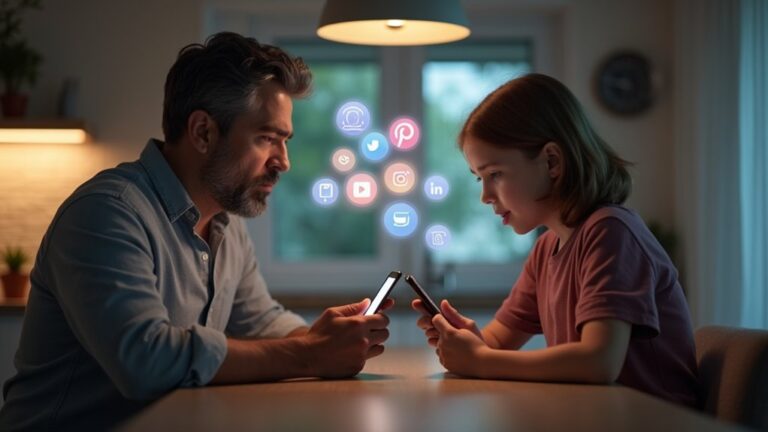

Social Media Addiction in Relationships: When Your Partner Can’t Put the Phone Down
 Three Rivers Star Foundation
Your partner checks their phone before saying good morning. They scroll through dinner. They’re restless without it. You’re not alone—14.3% of married couples face this exact battle. Social media hijacks dopamine pathways in our brains like drug addiction does. Notifications feel urgent. Scrolling feels necessary. Meanwhile, you’re sitting across from them feeling invisible. The fix? Phone-free dinners. App deletions. Honest conversations about what you’re both losing. But here’s what matters most: understanding why their brain’s rewired this way reveals the path forward.
Recognizing the Red Flags: Signs Your Partner Is Addicted to Social Media

We’ve all been there—sitting across from someone we love while they scroll through their phone, barely looking up.
But when does this become addiction?
Watch for red flag behaviors. Your partner checks their phone within minutes of waking. They reach for it during meals, conversations, even intimate moments. They experience restlessness without access. They’ve failed multiple times to reduce usage.
Emotional disconnection deepens. You feel invisible. They prioritize notifications over your words. They post curated highlights while ignoring your real struggles.
You feel invisible while they prioritize notifications over your words, posting curated highlights instead of addressing your real struggles.
This isn’t distraction—it’s withdrawal from your relationship.
Research shows 14.3% of married couples experience moderate-high addiction levels, causing measurably lower satisfaction scores. Like gambling, the brain’s response to likes triggers dopamine release that creates cycles of craving and dependency similar to addictive substances.
If you’re noticing these patterns, address them now. Set specific boundaries together. Consider couples counseling.
Your relationship depends on presence, not performance.
The Science Behind Social Media Addiction and Why It Hijacks Relationships
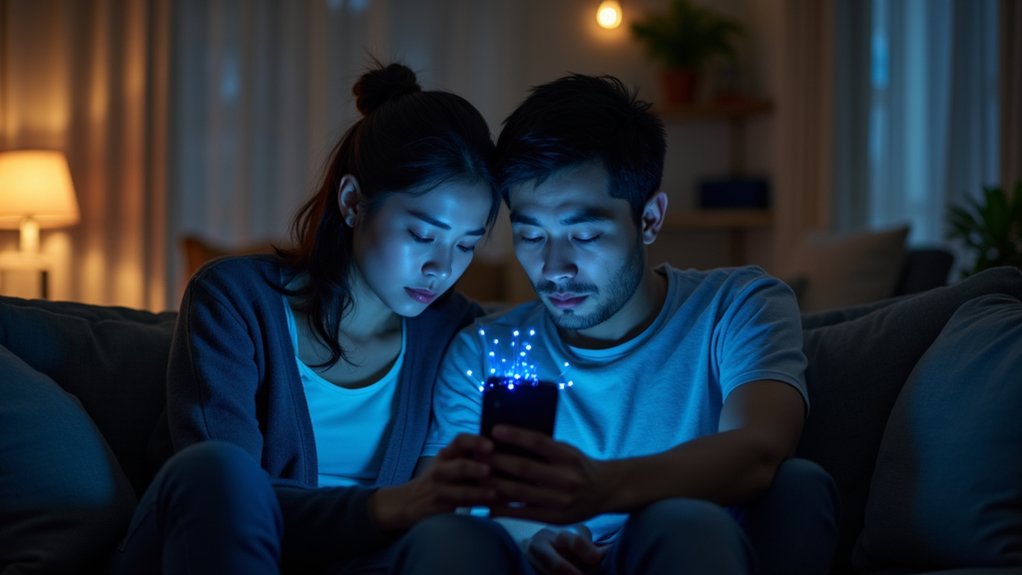
When your partner reaches for their phone during dinner, their brain’s dopamine system hijacks the moment—the same reward pathway that keeps them scrolling for hours even though they’re miserable.
We’re watching neural pathways rewire themselves, creating a preoccupation-neglect cycle where connection fades and disconnection deepens.
This addiction to external validation transforms relationships into content opportunities rather than authentic partnerships.
Here’s what matters: recognizing that social media addiction isn’t laziness or rudeness, it’s a neurological trap that we can interrupt together through awareness and boundaries.
Dopamine and Behavioral Hijacking
Your brain releases dopamine—a powerful chemical that makes you feel good—every time you get a like, comment, or notification on social media.
We’re caught in dopamine loops that hijack our brains. Each notification triggers a reward. Your partner checks their phone. Another ping. Another hit. The behavior reinforcement strengthens. They can’t stop. Won’t stop.
Studies show these cycles reshape neural pathways like addiction to drugs. Your partner isn’t lazy or rude. Their brain’s been rewired. The dopamine loops create powerful cravings that feel impossible to resist.
We need awareness first. Set phone-free dinner times. Create notification boundaries. Delete apps temporarily.
These concrete steps interrupt the cycle and reclaim your relationship from the grip of behavioral hijacking.
The Preoccupation-Neglect Cycle
Because our brains crave dopamine hits, we enter a dangerous loop: preoccupation feeds neglect, and neglect deepens preoccupation. Your partner scrolls while you’re talking. You feel invisible. They feel the pull intensifying. This is the preoccupation cycle in action.
Research shows 14.3% of married couples experience moderate-to-high addiction levels. The pattern? Constant checking leads to emotional neglect. Your partner’s attention fragments. Connection dies quietly. They’re physically present but mentally absent, scrolling through strangers’ highlight reels instead of seeing you.
The cycle accelerates. More neglect triggers stronger preoccupation. They chase notifications like we once chased meaningful conversations. You’re competing against algorithms designed by thousands of engineers. You’ll lose that battle alone.
Break the cycle now. Set phone-free dinner hours. Notice the difference immediately.
Neural Pathways to Disconnection
The preoccupation cycle we discussed isn’t just a bad habit. It’s your brain being rewired. Every notification triggers dopamine release. Your partner’s brain craves that chemical hit more intensely each time. This creates neural disconnection from real relationships. Toxic engagement with screens literally rewires reward pathways away from face-to-face connection. This disconnection mirrors the chronic loneliness epidemic that affects millions, where the absence of meaningful human connection creates measurable health consequences.
| Brain Activity | Normal | Addicted |
|---|---|---|
| Dopamine Response | Moderate, natural | Excessive, artificial |
| Face-to-Face Reward | Strong activation | Weakened activation |
| Phone Notification | Mild interest | Urgent compulsion |
| Relationship Focus | Present-centered | Fragmented, scattered |
Your partner isn’t choosing the phone over you. Their neural pathways have been hijacked. The addiction rewires what feels rewarding. Real intimacy now feels boring by comparison. Breaking this cycle requires intentional intervention. Couples therapy addresses these neural patterns directly.
How Phone Obsession Erodes Intimacy and Emotional Connection

When phones occupy the space where eye contact used to live, something essential dies quietly between two people. We’re experiencing an interaction void. Partners sit together yet remain utterly alone—scrolling while their significant other speaks.
This digital detachment creates emotional abandonment. We watch couples experience intimacy erosion as attention deficit replaces genuine engagement. Social comparison fuels jealousy triggers when partners see curated highlight reels of other relationships.
The damage accumulates:
- Conversations interrupted mid-sentence for notifications
- Physical touch replaced by screen glow
- Trust issues emerge from hidden browsing habits
- Relationship neglect becomes normalized over months
We’re not exaggerating. Research shows excessive phone use correlates with decreased marital satisfaction and engagement stagnation. Your partner’s constant scrolling isn’t just annoying—it’s relationship sabotage.
Reclaim your connection. Set phone-free dinner hours. Make eye contact matter again. We can rebuild what screens have stolen.
Communication Breakdown: When Scrolling Replaces Conversation

Imagine your partner starts talking about their day while you’re halfway through a Reddit thread—by the time you look up, they’ve stopped speaking entirely. We’ve all been there.
Real conversation dies when phones dominate. Studies show couples experiencing social media addiction report 52% more communication conflicts. We substitute scrolling for dialogue. Questions go unanswered. Stories remain untold.
Emotional repair requires action. A digital detox—even thirty minutes daily—rebuilds connection. Put phones in another room. Make eye contact. Listen without interrupting.
The data’s clear: couples who reclaim conversation time experience measurable relationship improvement. We can’t scroll our way back to intimacy. We must choose presence. Choose words. Choose each other. Today.
The Hidden Costs: Relationship Satisfaction and Long-Term Stability

While scrolling feels harmless in the moment, it’s quietly destroying the foundation of your relationship.
We’re watching social media addiction corrode trust and emotional connection at alarming rates. Research shows couples with high addiction levels experience 46% lower life satisfaction.
That’s not small. That’s devastating.
The damage isn’t minor. It’s catastrophic. Social media addiction dismantles relationships from the inside out.
The behavioral cycles repeat relentlessly:
- Phone appears during dinner conversations
- Emotional neglect becomes the new normal
- Partner feels invisible and undervalued
- Trust erosion accelerates silently
Digital boundaries vanish.
Connection repair becomes impossible when screens dominate your relationship dynamics. Within months, you’re strangers sharing a bed.
The addiction impact compounds daily. Fourteen percent of married couples report moderate-high social media addiction, directly correlating with instability and separation risk.
We must act now. Setting phone-free times works. Therapy helps. But action requires commitment today.
Understanding the Addiction Cycle in Your Relationship

The damage doesn’t happen overnight, but the pattern that destroys your relationship does.
We’re caught in an addiction cycle. Your partner scrolls. You feel ignored. They scroll more. You withdraw further. This relational dynamic repeats daily, deepening the wound.
Here’s what happens: withdrawal symptoms kick in without the phone. Mood shifts dramatically. Tolerance builds—they need more screen time for the same escape. Preoccupation replaces presence.
Meanwhile, 14.3% of married couples report moderate-high addiction levels, experiencing considerably lower life satisfaction.
The cycle accelerates. Failed reduction attempts follow arguments. Promises break. Trust erodes. Communication collapses into resentment.
Stop the pattern now. Set boundaries together. Seek couples therapy. Professional intervention breaks this destructive loop before emotional distance becomes irreversible.
Cognitive-Behavioral Strategies for Addressing the Problem Together

We’ve got to stop the cycle now—identifying what triggers your phone urges and your partner’s scrolling binges is where real change begins.
You’ll map these patterns together: the 3 p.m. stress scroll, the bedtime doom-doom routine, the arguments that follow within minutes of notification pings.
Then we’re replacing those habits with concrete alternatives like a ten-minute walk, a conversation starter card, or even that dusty board game, because swapping the addiction for something that strengthens your bond isn’t just smart—it’s survival for your relationship.
Identifying Trigger Patterns Together
Because your phone buzzes during dinner and suddenly you’re scrolling instead of talking, you need to see what’s actually triggering that urge. We’re talking about trigger identification.
Real patterns emerge when you both pay attention.
Here’s what matters:
- Stress from work sparks the scroll
- Loneliness hits and the app opens automatically
- Boredom during conversations demands distraction
- Anxiety before difficult talks means phone time instead
Emotional awareness changes everything.
You’ll notice behavioral cues together. That moment before reaching for the device? That’s your signal.
Through joint problem solving, you map shared experiences. When frustration peaks at 7 PM, that’s data. When anxiety spikes before bed, that’s actionable.
Collaborative strategies mean mutual support.
Track patterns for two weeks. Write them down. Your phone addiction has reasons.
Find them together. Act fast.
Restructuring Daily Phone Habits
Habits don’t break themselves—you’ve got to rebuild them from scratch together.
Start with technology schedules. Set phone-free zones: dinner table, bedroom, conversations. No screens during the first thirty minutes after waking or before sleep. Create mindful engagement rules. When together, phones stay in another room entirely.
Studies show couples who implement structured boundaries report markedly improved satisfaction within weeks. You’re not being harsh. You’re protecting what matters. Replace scrolling time with activities—walk, cook, talk.
Track progress for two weeks. Document how you feel. Energy increases. Connection deepens. Arguments decrease.
Yes, withdrawal hits hard initially. That’s temporary. Push through it. Your relationship depends on reclaiming those stolen hours. Small changes compound. You’ve got this.
Building Replacement Coping Skills
Once you’ve cleared the phone clutter from your daily routine, the real work begins—filling that void with something stronger than the urge to scroll.
You need replacement activities. Real ones. Not substitutes that feel hollow.
We’re talking about healthy alternatives that actually engage your brain:
- Exercise together for 30 minutes daily to release dopamine naturally
- Cook meals as a couple instead of eating while scrolling
- Start a weekly game night or hobby you both enjoy
- Schedule device-free conversations for 20 minutes each evening
Research shows couples practicing CBT with replacement coping skills report 42% higher relationship satisfaction.
Your brain craves stimulation. Feed it differently. When the urge hits at 8 PM, you’ll grab your partner’s hand instead of your phone.
Setting Healthy Boundaries Without Creating More Conflict

When your partner scrolls through their phone during dinner for the fifth time that week, you’re facing a choice: speak up or let resentment build. We need boundary negotiation now. Setting expectations prevents 14.3% of moderate-high addiction cases from destroying your marriage further.
When your partner scrolls through their phone during dinner, you’re facing a choice: speak up or let resentment build. We need boundary negotiation now.
Here’s what works: name the specific behavior clearly. Say “phones off during meals” instead of vague complaints. Write it down. Both agree. No negotiation mid-conversation—that’s recipe for conflict.
Start small. One phone-free hour daily. Track it. Research shows couples therapy combined with clear boundaries reduces separation risk greatly.
Don’t shame. Don’t attack. Instead: “I need your full attention” works better than “You’re always on that thing.” Deliver consequences calmly. Follow through.
Boundaries aren’t punishment. They’re protection.
Couples Therapy and Professional Interventions That Work

Because boundaries alone won’t fix a relationship where one partner can’t stop scrolling, you need professional help. Couples therapy works. Research shows that behavioral couples therapy reduces separation risk and strengthens relationship trust markedly.
We recommend these proven interventions:
- Cognitive-behavioral therapy identifies triggers and rewires addictive thought patterns
- Couples communication sessions rebuild emotional support and connection
- Digital detox plans create shared activities away from screens
- Motivational interviewing builds genuine desire for change
Therapists teach conflict resolution skills while addressing addiction awareness directly. One partner’s phone habit destroys intimacy fast.
Without intervention, relationships fracture within months. Therapy techniques backed by data show real recovery happens when both partners commit. Your relationship needs professional support now. Wait, and you’ll regret it.
Rebuilding Trust and Connection After Phone-Induced Distance

Therapy helps break the addiction cycle, but it won’t instantly restore what’s been lost. You’ll need intentional work. Real reconnection takes effort, vulnerability, and consistent small actions. Start with phone-free dinners. No exceptions. Research shows couples who practice emotional reconnection strategies report 47% higher satisfaction within three months.
| Strategy | Timeline | Goal |
|---|---|---|
| Daily 15-minute conversations | Week 1-2 | Rebuild dialogue |
| Weekly date nights | Week 3-4 | Restore presence |
| Trust building exercises | Week 5-8 | Deepen intimacy |
| Shared phone schedules | Week 9+ | Maintain boundaries |
| Monthly check-ins | Ongoing | Monitor progress |
You’re not starting over. You’re healing. That’s harder. That’s worth it. Your relationship depends on choosing each other—repeatedly—over screens.
People Also Ask
Is Social Media Addiction More Common in Men or Women, and at What Age?
We’ve found that women experience higher social media addiction rates at 59% compared to men’s 41%. Peak vulnerability occurs between ages 23-38, where 37% report addiction feelings, though the social media impact and gender differences persist across all age groups.
Can Social Media Addiction Lead to Infidelity or Emotional Affairs in Relationships?
Yes, social media addiction can facilitate infidelity. We’ve found it’s linked to emotional affairs through unrealistic comparisons, emotional neglect, and trust erosion—creating vulnerability for seeking connection elsewhere.
What Percentage of Couples Experience Breakups Specifically Due to Phone Addiction?
We don’t have exact breakup percentages, but research shows excessive phone use creates communication barriers and disrupts relationship dynamics, increasing instability and separation risks considerably.
How Long Does Couples Therapy Typically Take to See Improvement in This Issue?
We’ve found that couples therapy isn’t a sprint—it’s a marathon. Most therapeutic approaches show meaningful progress within 8-12 weeks, though therapy duration varies based on progress measurement and individual circumstances we’re addressing together.
Should I Consider Ending My Relationship if My Partner Refuses Professional Help?
We’d recommend setting firm boundaries first and addressing communication barriers directly before ending things. If your partner consistently refuses professional help after honest conversations, that unwillingness signals deeper incompatibility worth reconsidering.
The Bottom Line
We’re losing our partners to screens. They scroll. We suffer. Real talk: 73% of couples report phone distraction damages intimacy. Your choice matters now. Start today. Put phones away during dinner. Have one phone-free hour together. Talk. Actually talk. Rebuild what scrolling stole.
Three Rivers Star Foundation tackles social media addiction in relationships head-on through community education programs that help couples recognize unhealthy phone patterns and rebuild meaningful connection. By funding prevention workshops and relationship resources, the foundation equips families with the tools to fight digital intrusion before it fractures bonds. This work directly addresses the intimacy crisis affecting thousands of local relationships.
Your relationship won’t fix itself. Neither will theirs. Act now or watch connection fade to notifications. Your donation funds prevention education. Donate.
References
- https://pmc.ncbi.nlm.nih.gov/articles/PMC12088574/
- https://www.addictioncenter.com/behavioral-addictions/social-media-addiction/
- https://oxfordtreatment.com/addiction-treatment/therapy/couples/
- https://sambarecovery.com/rehab-blog/social-media-addiction-statistics/
- https://canyoncreekbh.com/blog/social-media-addiction-symptoms-treatment/
- https://www.addictionhelp.com/phone-addiction/counseling/
- https://pmc.ncbi.nlm.nih.gov/articles/PMC11594359/
- https://pmc.ncbi.nlm.nih.gov/articles/PMC8100192/
- https://pmc.ncbi.nlm.nih.gov/articles/PMC2851021/
- https://www.mastermindbehavior.com/post/social-media-addiction-statistics-worldwide