
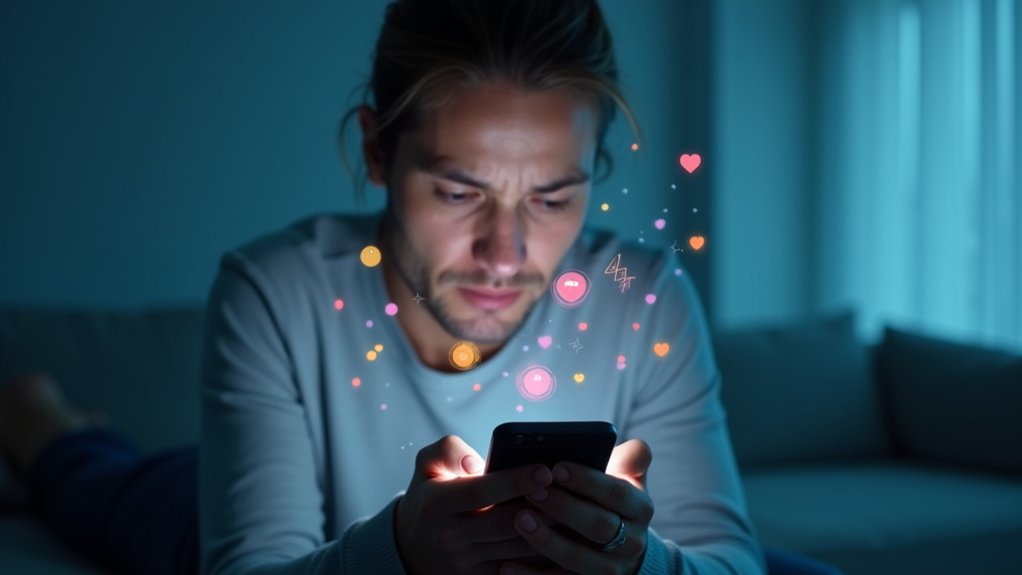
Are You Addicted to Social Media Validation? Take This Assessment
 Three Rivers Star Foundation
We’re checking our phones ninety-six times daily. Each notification triggers dopamine like gambling does. Your brain craves that validation hit. Likes feel real. Intimacy feels distant. Gen Z reports eighty-three percent can’t stop scrolling despite wanting to. Depression rates jumped sixty-three percent among heavy users. You’re not weak—these platforms engineer addiction deliberately. A twelve-question assessment reveals your dependency level. Scores reveal everything: balanced habits to severe dependency requiring immediate detox. Your recovery path awaits with concrete action steps tailored to your addiction stage.
The Story of Sarah: When Likes Matter More Than Love

When Sarah refreshed her Instagram feed at 6 a.m., before her feet touched the floor, she wasn’t checking the news or messages—she was hunting for validation. She posted a selfie.
Waited.
Refreshed.
Checked comments.
Nothing yet.
Her stomach tightened.
By noon, fifty likes arrived. Relief flooded through her. We recognize this pattern everywhere now. The Social Media Impact on validation effects runs deep.
By noon, the validation arrived. Relief flooded through. We recognize this pattern everywhere now—the social media validation effect runs deep.
Sarah’s dopamine spiked with each notification, mimicking gambling’s neural pathways. Her brain rewired itself around those digital rewards.
Here’s what matters: 83% of Gen Z tried limiting use but failed. Sarah couldn’t stop either. She craved that hit more than genuine connection with her boyfriend. Validation addiction, rooted in the brain’s dopamine response system, had become more compelling than real intimacy.
The likes mattered more than love.
We need awareness. Track your notifications. Set boundaries. Reclaim what matters most—real relationships, not digital approval.
Understanding Validation Addiction: The Science Behind the Scroll
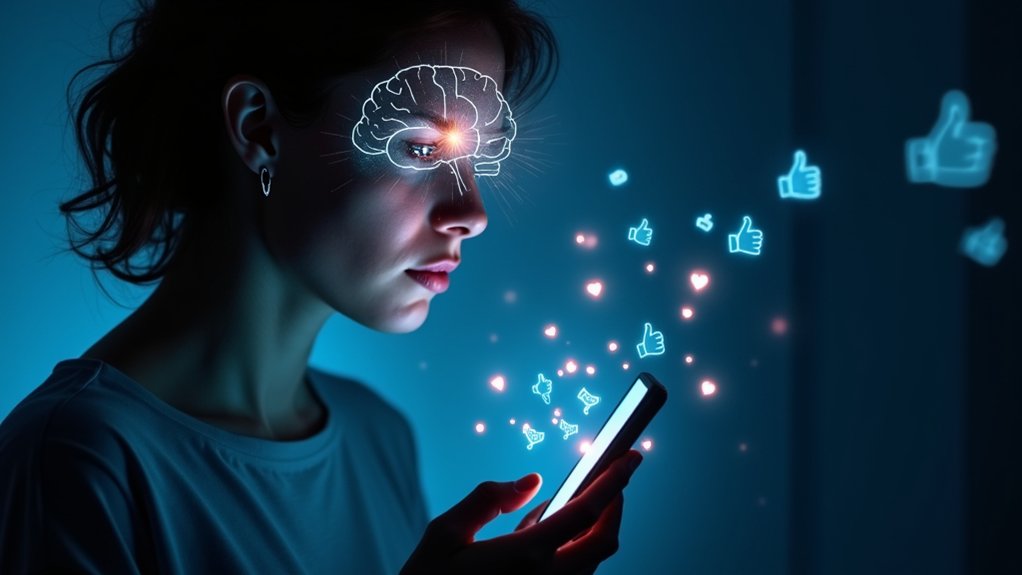
We’re caught in a dopamine loop.
Every like, every comment triggers the same reward pathway that narcotics activate in our brains, and platforms engineer this deliberately to keep us scrolling deeper into comparison traps where we measure our worth against carefully filtered highlight reels.
The science is stark: our neural pathways rewire with each validation hit, making quitting as hard as breaking any addiction.
Dopamine Loops and Addiction
Every time you refresh your feed, your brain releases a chemical called dopamine—the same one triggered by gambling, drugs, and eating sugar.
We’re trapped in dopamine loops that designers built intentionally.
Here’s how it works:
- Each like triggers dopamine release in your brain’s reward center
- You crave that hit, so you check again. And again.
- The algorithm knows this. It’s engineered for validation dependence.
- Failed attempts to quit prove the addiction is real
- Your brain rewires itself to chase digital validation constantly
The dopamine feedback cycle is brutal.
One notification. Your heart races. You access your phone immediately.
That’s not willpower failing—that’s neuroscience winning.
We’re literally addicted to seeking approval from strangers online. Recognizing this trap is step one toward breaking free.
The Comparison Trap Effect
Because your brain compares itself to everyone’s highlight reel, you’re losing.
We scroll through filtered perfection and feel broken. Studies show 47% of us experience increased anxiety and loneliness from this trap. Your friend posts vacation photos. You’re home scrolling. That gap? It’s engineered. Algorithms show you curated wins, not reality.
Comparison awareness matters now. Notice when you’re measuring yourself against someone else’s best moment. Social norms shift dangerously when everyone projects fake success. We internalize impossible standards. The result: 63% depression increase among heavy users.
Stop the cycle. Limit scrolling to thirty minutes daily. Follow accounts that inspire rather than drain. Remember: what you’re seeing isn’t real. Your actual life deserves your attention.
Neural Pathways Like Narcotics
Your phone buzzes. That dopamine hit floods your brain. We’re not exaggerating—social media triggers the same neural pathways as narcotics and gambling addiction.
Here’s what’s happening inside your head:
- Each like activates reward centers identical to cocaine use
- Your brain craves validation the way it craves drugs
- Neural addiction strengthens with repeated scrolling cycles
- Digital dependency rewires how you seek pleasure
- Notifications hijack your attention like an actual substance
Studies show our brains can’t distinguish between real rewards and digital ones. We scroll. We seek likes. Our neural circuits fire. Again. Again.
Forty percent of teens struggle to quit despite wanting to. The science is clear: we’re building genuine addictions, not just bad habits.
Stop treating this casually. Your brain’s wiring depends on it.
How Social Media Platforms Engineer Your Dopamine Response
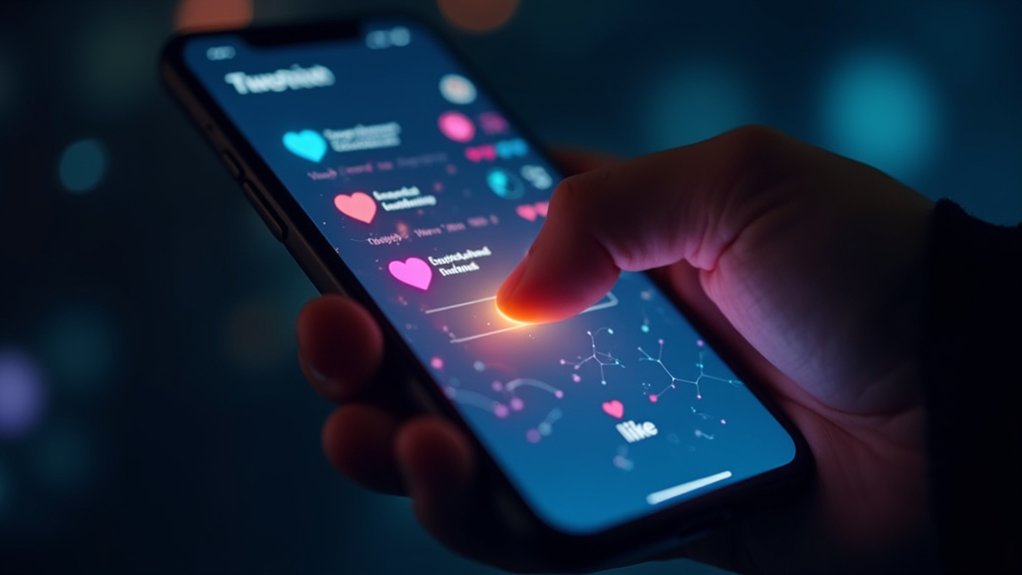
every like, comment, and share floods your brain with dopamine—the same chemical that hooks people on gambling and drugs.
Platforms like TikTok, Instagram, and Facebook didn’t accidentally design their algorithms this way; they engineered them deliberately to keep you scrolling, checking back within minutes, trapped in a reward loop that’s nearly impossible to escape.
We’re not just using these apps—we’re being used by them, and understanding how they manipulate our brain’s reward system is the first step toward breaking free.
The Reward Loop Design
Social media platforms have cracked the code on addiction—and they’re weaponizing it against us. We scroll. We post. We wait. That dopamine hit arrives when someone likes our photo, and we’re hooked.
Here’s how the reward mechanism traps us:
- Intermittent reinforcement: Unpredictable likes keep us checking constantly, like slot machines.
- Notification alerts: Every ping triggers anticipation and compulsive return visits.
- Endless feeds: Algorithms serve personalized content designed specifically for maximum user engagement.
- Social proof: Visible metrics (counts, shares) validate our worth through quantification.
- Streaks and badges: Gamification artificially creates urgency and fear of missing rewards.
We’re not using these platforms. They’re using us.
Scientists confirm: our brains respond identically to social validation and cocaine. That’s intentional design, not accident. We must recognize the trap before reclaiming our attention.
Algorithmic Manipulation of Cravings
While we think we’re choosing what to scroll, algorithms are choosing what we see—and they’re doing it deliberately to keep us craving more.
These platforms engineer algorithmic cravings by studying exactly what makes you stop scrolling. They track your every click, pause, and like. Then they weaponize that data.
Here’s how the manipulation tactics work: You see a post. Your heart races slightly. You like it. Dopamine floods your brain—the same chemical released during gambling.
Platforms know this. They’ve designed feeds to maximize these hits, spacing rewards perfectly to keep you hooked. One study showed users check social media 49 times daily seeking validation.
Stop the cycle now. Set phone limits. Delete apps during vulnerable hours. Your attention deserves protection.
The Validation Cycle: From Posting to Compulsive Checking
The moment you hit post, your brain starts waiting. We refresh. We check. We refresh again. That’s the validation feedback loop—and it’s designed to trap us.
The validation feedback loop begins the moment you post—refresh, check, refresh again. It’s deliberately designed to trap us.
Your post goes live. Dopamine spikes. You’re hooked. Within minutes, you’re checking for likes, comments, shares. This compulsive behavior isn’t random. It’s engineered.
Here’s what happens:
- Notifications trigger reward pathways in your brain like gambling
- Each like releases dopamine, reinforcing the checking habit
- You post more frequently seeking that validation rush
- Failed attempts to stop intensify the cycle
- Screen time climbs from minutes to hours daily
The data’s stark: 83% of Gen Z tried limiting use but failed.
We’re caught between posting and compulsive checking, trapped in a validation loop that’s deliberately designed to keep us scrolling.
Recognition is the first step toward breaking free.
Your Social Media Validation Assessment: 12 Questions to Know

Now that you understand how the validation cycle traps you, it’s time to measure where you actually stand.
We’ve created twelve targeted questions revealing your validation dependence level. Answer honestly about your checking habits, emotional reactions to likes, and mood swings after posting.
Do you refresh constantly? Feel anxious without notifications? These questions expose patterns you might ignore daily. The social media impact on your brain is measurable and real.
Research shows 83% of Gen Z attempted limiting use unsuccessfully. Your answers determine whether you’re scrolling casually or caught in addiction’s grip.
We’re not here to judge. We’re here to help you see clearly. Take the assessment. Count your honest responses. Then decide what changes matter most for your mental health and genuine relationships.
Scoring Your Results: What Your Answers Reveal

Your score reveals something essential: whether you’re in control or your phone is in control of you.
Your score reveals something essential: whether you’re in control or your phone is in control of you.
Scores between 12-24 suggest healthy habits. You’re scrolling without obsessing.
Scores 25-36 signal caution. You’re seeking validation more than you realize.
Scores 37-48 demand attention. Your mental health is deteriorating.
Scores 49-60 mean crisis. You need a digital detox now.
We see the pattern clearly:
- 12-24 points: Balanced user maintaining perspective
- 25-36 points: Validation-seeking increasing, awareness growing
- 37-48 points: Addiction symptoms emerging, intervention needed
- 49-60 points: Severe dependency affecting daily function
- Action required: Start a digital detox immediately at any elevated score
Don’t ignore these numbers. Your brain chemistry is being rewired by algorithms designed to addict you.
Take action today.
Low Addiction Level: You’re in Control

Congratulations—you’ve scored between 12 and 24 points, placing you in the rare category of balanced users who actually control their phones instead of letting phones control them.
You’re doing something most people struggle with. We’re talking about only 4.69% of social media users worldwide maintaining this balance. Your mental health likely isn’t tanking from endless scrolling. The social media effects you’re experiencing remain minimal.
Keep this momentum going. Don’t slip into the trap that captures millions daily. Set specific time limits now. Check your phone intentionally, not obsessively. Notice when urges hit hardest.
Your discipline today prevents depression and anxiety tomorrow. Stay vigilant. Balance doesn’t last without continuous effort.
Medium Addiction Level: Time to Set Boundaries

We’re spending 5-9 hours daily scrolling while our brains crave dopamine hits from likes and comments like a slot machine addiction.
You’ve probably noticed you check your phone 49 times before breakfast, promise yourself you’ll quit tomorrow, and feel that familiar anxiety when you can’t find your device.
It’s time we face the numbers: medium addiction means setting hard boundaries now—like deleting apps from our home screens, scheduling phone-free hours, and tracking what we actually do online—before we drift into the heavy user zone where 12 billion global hours vanish daily.
Recognizing Your Usage Patterns
How many times have you checked your phone in the last hour?
We’re not judging. Most of us do it constantly without realizing it.
Let’s be honest about our habits:
- You pick up your phone before finishing breakfast
- Notifications pull your attention every few minutes
- You scroll through feeds during conversations
- Evening screen time extends past midnight regularly
- You feel anxious when your phone isn’t nearby
Adults check social media over forty times daily on average.
Teens hit fifty-one times.
This pattern signals medium addiction. Your usage isn’t catastrophic yet, but it’s escalating.
A social media detox doesn’t mean quitting forever.
Digital mindfulness means noticing these patterns first.
Track your actual screen time for three days.
Write down when you reach for your phone.
Document what triggers each check.
These concrete observations reveal your real dependency level.
Boundaries now prevent deeper addiction later.
Creating Effective Digital Limits
When do you finally reclaim your time?
We’re losing hours. Every day. Studies show teens spend 4.8 hours scrolling while adults check Facebook over once daily. That’s 12 billion global hours vanishing into feeds.
Here’s what works: set hard screen time limits. Not suggestions. Rules.
Delete apps from your phone. Install them only on your computer. Use your device’s built-in timer—it’ll force you off at set times.
Start a digital detox. One week. No social media. Notice how your anxiety drops. Your sleep improves. Your focus sharpens.
We can’t outsmart the algorithms designed to trap us.
But we can outsmart ourselves. Set boundaries now before addiction deepens its grip.
High Addiction Level: When Validation Becomes Harmful

Because the human brain treats social media likes identically to gambling winnings, addiction intensifies when validation becomes the primary fuel.
We’re chasing dopamine hits. Each notification triggers the same reward pathways as gambling does.
When validation psychology takes over, we can’t stop scrolling:
- Checking phones 50+ times daily for approval
- Feeling worthless without likes within minutes
- Posting strategically to maximize engagement metrics
- Experiencing anxiety when notifications drop
- Sacrificing sleep, work, and real relationships for online approval
Your brain rewires itself. Validation becomes necessity, not bonus.
A digital detox isn’t optional anymore—it’s critical.
We must reclaim our worth from external sources. Delete the apps. Reconnect with people face-to-face. Your mental health depends on it.
The Relationship Damage: How Validation-Seeking Erodes Intimacy
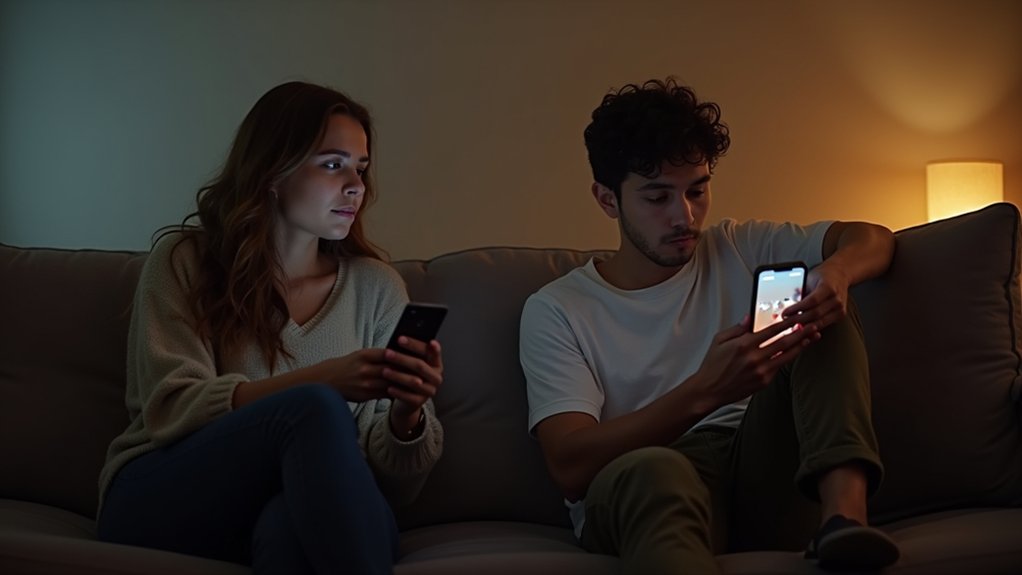
While you’re rejuvenating Instagram for the hundredth time today, your partner sits across the table feeling invisible.
While scrolling through endless feeds, your partner sits across the table feeling invisible.
We’re experiencing validation erosion in real relationships. Every notification pull fragments your attention. Your partner notices. Studies show 67% of adults link social media to isolation and loneliness. Intimacy decline follows predictably. We crave digital likes instead of eye contact.
We scroll through curated lives while ignoring the real person beside us. The relationship suffers quietly. You’re both present yet absent.
Here’s what happens: trust weakens, conversations shallow, physical connection fades. After six months of this pattern, couples report feeling like roommates.
Set phone-free dinner times. Practice eye contact. Delete apps from your bedroom.
Your relationship matters more than metrics. Choose presence over validation. Choose them.
Action Steps for Each Addiction Level: Your Recovery Path

As your addiction level rises, so does your recovery toolkit need to expand. We’re not talking about willpower anymore. Real change requires structured action.
Your path depends on severity:
- Mild users practice digital mindfulness through scheduled phone checks twice daily.
- Moderate addicts commit to a three-day social media detox every month.
- Heavy users delete apps entirely for two weeks, replacing scrolling with walks.
- Severe cases seek professional help alongside a 30-day complete digital detox.
- All levels track screen time daily using built-in phone tools.
Start today. Pick your level. The teens spending 4.8 hours daily aren’t recovering by accident. Neither will you.
Your brain rewired itself to crave validation. Now we rewire it back.
Resources and Tools to Reclaim Your Life Beyond the Screen

You’ve committed to change—now comes the hard part: actually staying committed without slipping back into the scroll.
We need real tools. Real barriers.
Download app blockers. Set them for 6 p.m. to 8 a.m. daily. Research shows 51% of teens spend 4.8 hours scrolling—you won’t be that statistic.
Delete notifications entirely. Every ping hijacks your brain’s dopamine pathways like gambling machines do.
Practice Mindful Engagement: check platforms once daily, intentionally, for fifteen minutes maximum. A Digital Detox means phone-free meals, bedrooms, and conversations.
Replace scrolling time with walks, reading, creating something real.
Track your wins. Day three feels impossible. Day seven? You’ll notice sharper focus, better sleep, less anxiety. The craving fades.
You reclaim your attention. Your life depends on it.
People Also Ask
What Percentage of Social Media Users Worldwide Are Actually Addicted to Validation?
We’re seeing roughly 4.69% of global social media users meeting addiction criteria, though addiction trends suggest this figure’s likely underestimated. When we examine excessive usage patterns and validation-seeking behaviors, our global statistics indicate substantially higher rates among vulnerable demographics.
Which Social Media Platforms Are Scientifically Proven Most Addictive for Validation-Seeking Behavior?
We’re caught in Pavlov’s digital experiment. TikTok, Instagram, and Facebook rank as scientifically most addictive—Instagram likes and TikTok engagement trigger dopamine releases mimicking gambling, engineering our validation-seeking behavior through algorithmic reward systems.
How Does Social Media Validation Addiction Differ From Other Behavioral Addictions Like Gambling?
We’re hooked on validation addiction differently than gambling because social comparison constantly feeds our emotional reinforcement cycle. Likes and comments trigger dopamine rewards through personal identity validation rather than chance-based outcomes.
At What Daily Usage Threshold Does Validation-Seeking Become Clinically Considered Addiction?
We’re caught in a paradox: there’s no official threshold, yet research suggests 5+ daily hours correlates with depression and anxiety. We’ve found mental health declines sharply beyond this point, though individual vulnerability varies considerably.
Are There Demographic Groups More Vulnerable to Social Media Validation Addiction Than Others?
We’ve identified that youth demographics show the highest vulnerability, with up to 70% of US teens struggling with validation addiction. Gender differences exist too—60% of men and 55% of women exhibit unhealthy habits.
The Bottom Line
We’re literally checking our phones a million times daily. Stop. Notice the pattern. You post. You wait. You refresh. That’s the cycle breaking us. Three actionable steps: disable notifications today, schedule phone-free hours, reach out to one real person this week.
Three Rivers Star Foundation recognizes that social media validation addiction fuels anxiety, erodes self-worth, and deepens isolation among young people. Through evidence-based prevention programs and digital wellness education, the foundation teaches individuals to recognize addictive patterns, build healthier relationships with technology, and strengthen genuine human connection. By equipping communities with these tools, Three Rivers Star Foundation directly addresses the psychological and social damage of constant validation-seeking.
We can’t reclaim our lives by scrolling. We reclaim them by choosing presence. Choose it now. Choose it tomorrow. Choose it always.
Your donation funds prevention education. Donate.
References
- https://brandwell.ai/blog/social-media-addiction-statistics/
- https://www.magnetaba.com/blog/social-media-addiction-statistics-worldwide
- https://explodingtopics.com/blog/social-media-addiction
- https://www.addictionhelp.com/social-media-addiction/statistics/
- https://www.pewresearch.org/internet/2025/11/20/americans-social-media-use-2025/
- https://www.lanierlawfirm.com/product-liability/social-media-addiction-lawsuit/statistics/
- https://journals.publishing.umich.edu/ujph/article/id/7607/